M. Everett Lawson
Resonant Environment: Active Planetary Systems
The transmissions of our voices, music, and global interconnectivity dominate the natural landscape.
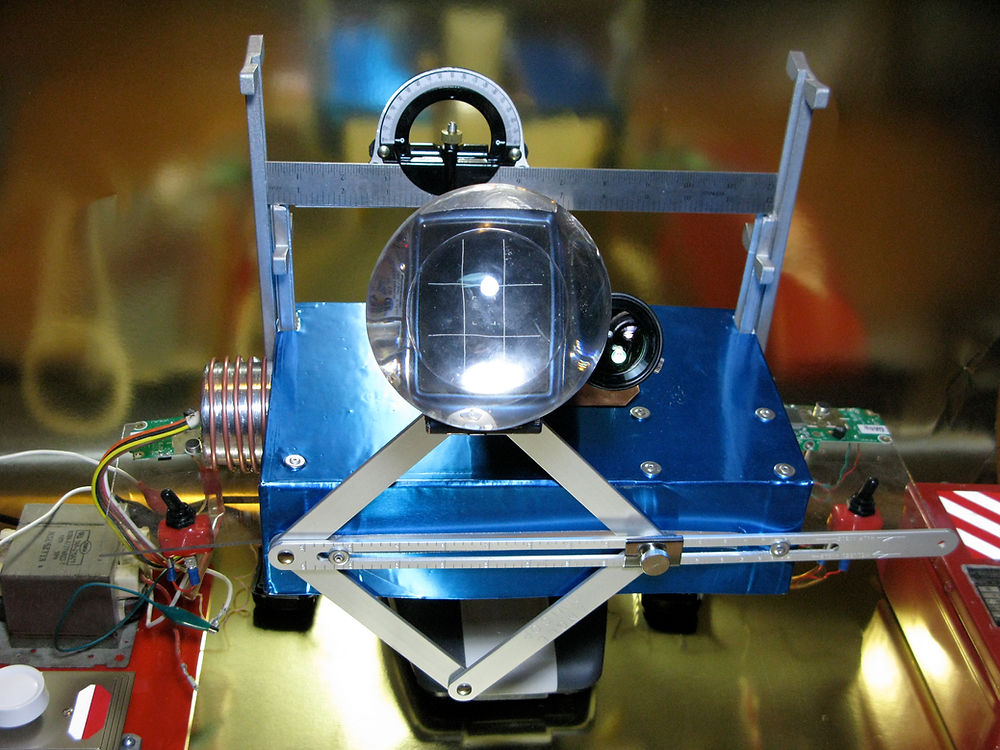
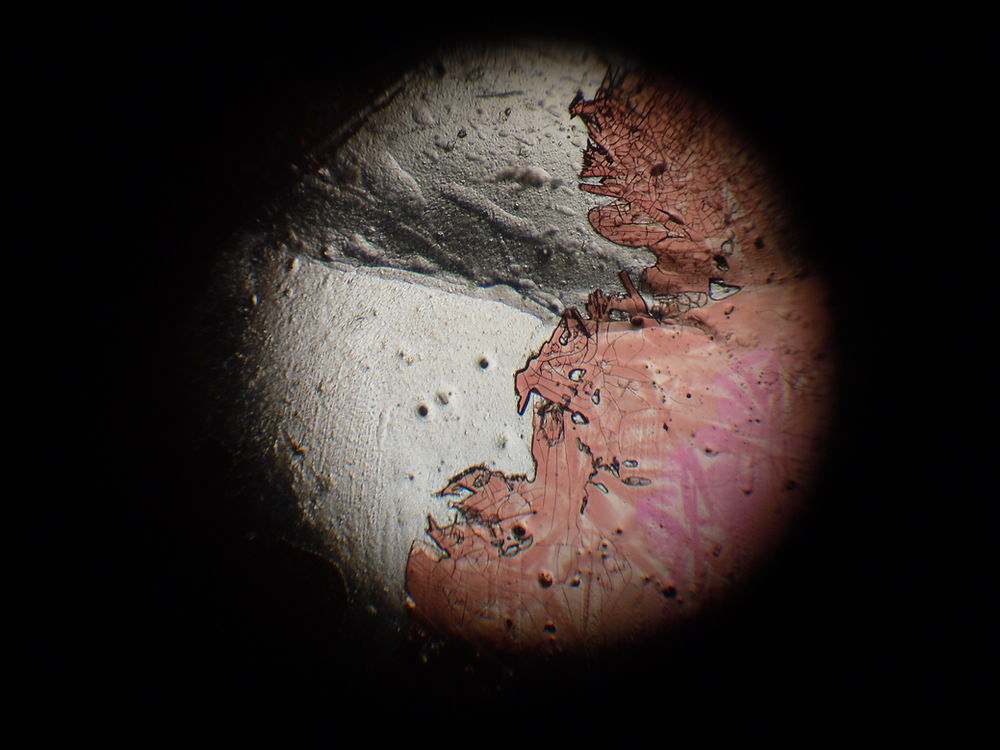
The structures of individual cells, and the molecular harmonics of differing atoms in organic matter create the potential for new relationships in natural design. Through the use of microwave and radio transmissions, manipulated by musical compositions, I compose living organic matter orchestrated through the manipulation of frequency. Resonant environment is the first body of work to come from the microscope platform. The lenses are hand-ground specifically to create a sense of depth at 12,000 x magnification to quietly reveal distant actions as a system of planetary forms. These images were made from a single sample of my living blood as it creates new relationships from within orchestrated by compositions performed on my violin. Different compositions have different effects. As I perform I am able to see in real-time the organic compositions as they form and transform, forging new relationships and interactions, giving me a new medium with which to address our culture’s impact as it subtly imparts its presence in every vestige of nature’s growth.
The Challenge
When we think of photography today, we think of cameras capturing light, moments, surfaces — not living processes in real-time. The impossible problem at the heart of Resonant Environment was to visualize emergent organic systems as performative events, not static objects: to compose images from the inside of matter itself, while performing. Imagine trying to photograph a planetary system… that’s alive, unfolding, and responding to melody in real time. Conventional photography freezes time; this work weaves it.
The Insight
Most photographers ask “what is the world?” but this project asked “what worlds emerge when the artist becomes a vibrational agent within a system?” By using a microscope rig with hand-ground lenses and coupling it with live musical performance, the artist didn’t capture imagery — he provoked it into being. The insight was that fine art photography doesn’t have to merely record reality — it can generate realities from within biological and physical processes, turning frequency into form and performance into image.
The Execution
The process unfolds like a ritual and a scientific experiment merged:
-
Instrument + Optics Integration
A bespoke microscope platform with custom hand-ground lenses — capable of 12,000× magnification — becomes both camera and collaborator. (M. Everett Lawson) -
Performance as Medium
As the artist plays violin compositions, live organic matter (a sample of blood) responds. The frequencies emitted aren’t just sound — they become forces shaping the organic world under observation. (M. Everett Lawson) -
Real-Time Visualization
Unlike time-slice captures, each exposure is a live history of action — a photographic score of movement and transformation, set by the composition played. (M. Everett Lawson) -
Photography as Ecology
The images are not frozen moments but maps of emergent relationships — electrons, cells, and frequencies in active dialogue, as if entire planetary systems are composing themselves through resonance. (M. Everett Lawson)
High-resolution visuals from the archive evoke celestial formations — spirals, cores, emergent constellations — yet they are born from micro-scale biological choreography.
Impact
Resonant Environment doesn’t just expand the definition of photography — it obliterates it, replacing passive observation with participatory creation. It gestures toward a new kind of imaging where aesthetic, sonic, and biological systems co-compose. While not yet mainstream, this work has rippled through avant-garde circles as a visceral challenge to deterministic, object-based imaging. It opens productive questions in performance art, experimental photography, and scientific visualization: when does an image stop being a record and start being a performed world?
1. Interaction Design
Interaction here isn’t UI — it’s biological.
This project reframes interaction as a closed-loop system between performer, instrument, optics, and living matter. Every gesture, bow pressure, and harmonic shift directly alters the visual outcome. The performer doesn’t operate a system — they inhabit it.
ECXD relevance
-
Redefines interaction beyond screens and controls
-
Demonstrates embodied, sensory-driven input models
-
Explores feedback loops where output reshapes input in real time
Why this matters at Netflix
Netflix experiences increasingly move beyond clicks — into spatial, gestural, and emotionally driven interactions. This work proves fluency in designing non-verbal, non-linear interaction systems where meaning emerges from behavior, not buttons.
2. Cinematic UX
The image isn’t framed — it’s conjured.
Each photographic result feels less like documentation and more like a reveal. Viewers don’t just look at the image — they feel that it was summoned through time, motion, and performance. The experience mirrors cinema’s core power: tension, anticipation, emergence.
ECXD relevance
-
Treats time as a narrative material
-
Builds emotional payoff through process, not polish
-
Creates visual gravity without traditional cinematic tools
Why this matters at Netflix
Netflix UX increasingly borrows from cinematic language — pacing, reveal, mood, presence. This project shows mastery of cinematic storytelling without relying on linear playback, a key ECXD strength.
3. Motion Systems
Motion is not animation — it’s causality.
Movement here isn’t decorative. Frequency, vibration, and resonance are the engines that generate form. Motion becomes the invisible system beneath the image — the reason the image exists at all.
ECXD relevance
-
Motion as a generative system, not a layer
-
Demonstrates cause-and-effect motion logic
-
Aligns motion behavior with meaning
Why this matters at Netflix
ECXD motion systems aren’t about transitions — they’re about making invisible systems legible. This project does exactly that, using motion to expose underlying forces rather than mask them.
ECXD PULL QUOTES
“The image isn’t captured — it’s provoked.”
“Performance is no longer in front of the camera.
It is the camera.”
“What if photography didn’t freeze time,
but revealed what time was doing underneath?”
“Motion isn’t animated here — it’s causal.”
“This is what happens when frequency is treated as a design material.”
HOW THIS PROJECT POSITIONS YOU FOR ECXD
This case study quietly but unmistakably signals:
-
Comfort operating between art, science, and technology
-
Ability to design systems, not surfaces
-
Deep intuition for cinematic experience without cinematic clichés
-
A belief that interaction is emotional and bodily, not procedural
In an ECXD portfolio, Resonant Environment plays the role of:
“This person doesn’t just design experiences — they discover new ones.”
ECXD-STYLE HEADLINES
Photography stops recording.
Systems start performing.
A camera that listens.
An image that remembers.
When interaction becomes vibration,
images become events.
This isn’t a photograph.
It’s a consequence.
A living system, briefly convinced to show itself.