M. Everett Lawson
Visual Decomposition: Compartment 1
A study in perception, time, and the raw mechanics of seeing
Overview
Visual Decomposition: Compartment 1 is an experimental perceptual system that reframes vision as a time-based, cinematic process rather than a static image. By physically decomposing the act of seeing down to a singular sensory channel, the project explores how motion, duration, and performance can be encoded directly into perception — without simulation, UI, or post-processing.
This work functions as perceptual R&D, probing how future immersive and augmented experiences might communicate meaning by aligning with biological vision rather than competing with it.
Challenge
Designing for vision — not screens
“Most visual systems add layers. This one removed almost everything.”
Modern AR, UX, and cinematic interfaces assume vision is best served through overlays, icons, and frames. The challenge here was fundamentally different:
Can meaning emerge by subtracting visual information instead of adding it?
Specifically:
-
How do you visualize time without timelines?
-
How do you encode motion without animation?
-
How do you create an experience when perception itself is the medium?
This required abandoning traditional interaction paradigms and working directly with the physics and physiology of seeing.
Insight
Perception is already a motion system
“Vision doesn’t see frames — it integrates change.”
The key realization was that vision is not a snapshot mechanism — it is a temporal integrator. By isolating a single perceptual channel (analogous to a narrow slice of photoreceptor input), motion and duration could be collapsed into visible structure.
Instead of simulating motion computationally, the system lets motion write itself into the image.
Time becomes spatial. Performance becomes geometry. The image becomes evidence of perception.
This insight anticipates a broader ECXD principle: cinematic experience emerges from how information unfolds, not how much is shown.
Execution
A cinematic system without a screen language
“No UI. No edits. No overlays. Just perception doing the work.”
-
Built a custom, large-scale analog imaging apparatus from repurposed optical and photosensitive components.
-
Captured performative motion as continuous perceptual traces, not discrete frames.
-
Produced high-resolution outputs that compress entire actions into single, cinematic artifacts.
-
Eliminated post-processing to preserve the integrity of the perceptual system.
Interaction is implicit: the viewer reconstructs motion, intent, and time through their own visual processing. The experience unfolds mentally — like cinema without cuts.
Impact
Reframing AR as perceptual alignment
“Augmentation doesn’t have to add pixels — it can add understanding.”
While not a commercial product, this project directly influenced later work in:
-
Peripheral semantic systems
-
Biologically encoded AR
-
Motion-driven meaning systems
Its impact lies in shifting the design question from “What do we overlay?”
“Where — and how — should meaning enter the human perceptual pipeline?”
Cinematic UX
Storytelling through time, motion, and reveal
“Each image is a compressed performance.”
-
Time functions as narrative structure.
-
Motion replaces editing.
-
Viewer reconstructs story through anticipation and persistence.
“This is the kind of work that expands the design vocabulary — not just the product roadmap.”
Motion Systems
Motion as meaning, not decoration
“Motion isn’t animated — it’s encoded.”
-
Motion generates form.
-
Duration becomes data.
Anticipates motion systems where animation carries semantic weight.
Motion Systems
-
Motion is not decoration — it is the data layer.
-
The system encodes meaning through the physical behavior of light, movement, and temporal accumulation.
-
This directly anticipates ECXD’s interest in motion as infrastructure — where animation carries semantic weight, not just polish.
ECXD signal: Designing motion systems that communicate rather than merely animate.
Why This Matters to Netflix ECXD
Visual Decomposition: Compartment 1 isn’t a content piece — it’s a perceptual R&D probe.
It demonstrates:
-
Comfort working at the intersection of art, science, and experiential systems
-
A willingness to challenge display-centric thinking in favor of human-centric perception
-
A design philosophy aligned with ECXD’s mandate to invent new experiential languages — not just new screens
At its core, this project argues that the future of immersive media doesn’t begin with devices.
It begins with understanding the audience’s biology — and designing directly for it.
The art of tone addresses the complexity of musical articulations, chordal patterns, and compositional forms into a new visual tapestry touching on the performative aspect inherent in the photographic medium.
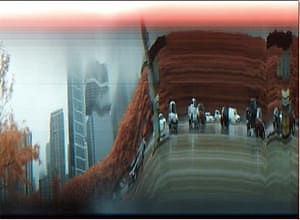
Thinking of the human visual system as a complex matrix of time-limited interactions, which are constantly decoding meaning in the action of sight, I wanted to isolate a single rod or cone and, in this case, a single row of sensors in order to create a singular perspective through time as the starting point to create this ongoing body of work. Images that are not confused by the superposition of surrounding receptive fields. For this, I built the head camera which embodies a variety of materials including bits of a heart defibrillator, lenses ground from lead crystal prisms and one of my first homemade rectilinear photosensitive cells. What it offers is a perspective in space and time that our complex retinas, eyes, do not allow us to consciously perceive. It allows for performative actions to be captured in their entirety within the space of a single frame. They are single exposures expressive of entire performances, in nature they are complicated performative pieces to make, some of which take days of focused preparation. They are not optical distortions created by the irregularities in the lens, or in any way manipulated with a computer in post-production, but reveal instead a focused compression of time through a singular space, commenting on two of the most important works in the 20th century, that of the relativity of space-time as interconnected and Heisenberg’s uncertainty principle.
In the same way that time can be compressed it like wise can be expanded through the variables of perspective, and space. This is the first digital camera I created which is nearly three feet across, makes an absolutely horrible noise and has enough copper in it to make about 2000 pennies and is most sensitive to ultraviolet light. Conceptually it was made to address the human form as a set of generalities. The Third Book, address the human form as a set of generalities. Inspired from Herodotus’s the history, form is omnipresent, rulers and god-forms of great deed. His writing inspires the greatest struggles of humanity and the momentary bliss of engaging mortality.